
The Gallaudet AAUP chapter administered a survey in October 2023 to all Gallaudet full-time faculty via our email listserv, asking about the climate at Gallaudet. Many faculty respondents did not feel safe expressing their viewpoints, a majority had no confidence in the administration, and many reported looking for other jobs. The Gallaudet AAUP chapter’s advocacy work is viewed as effective, leading to hope for positive change.
Safe Expression of Opinions and Academic Freedom
Only 5% of respondents reported a feeling of complete safety in expressing their opinions on campus, including support of AAUP. On a four-point scale where 1 = “I feel unsafe” and 4 = “I feel completely safe,” nearly two-thirds (63%) of respondents chose 1 or 2 (median = 2.0).

Confidence in the Administration
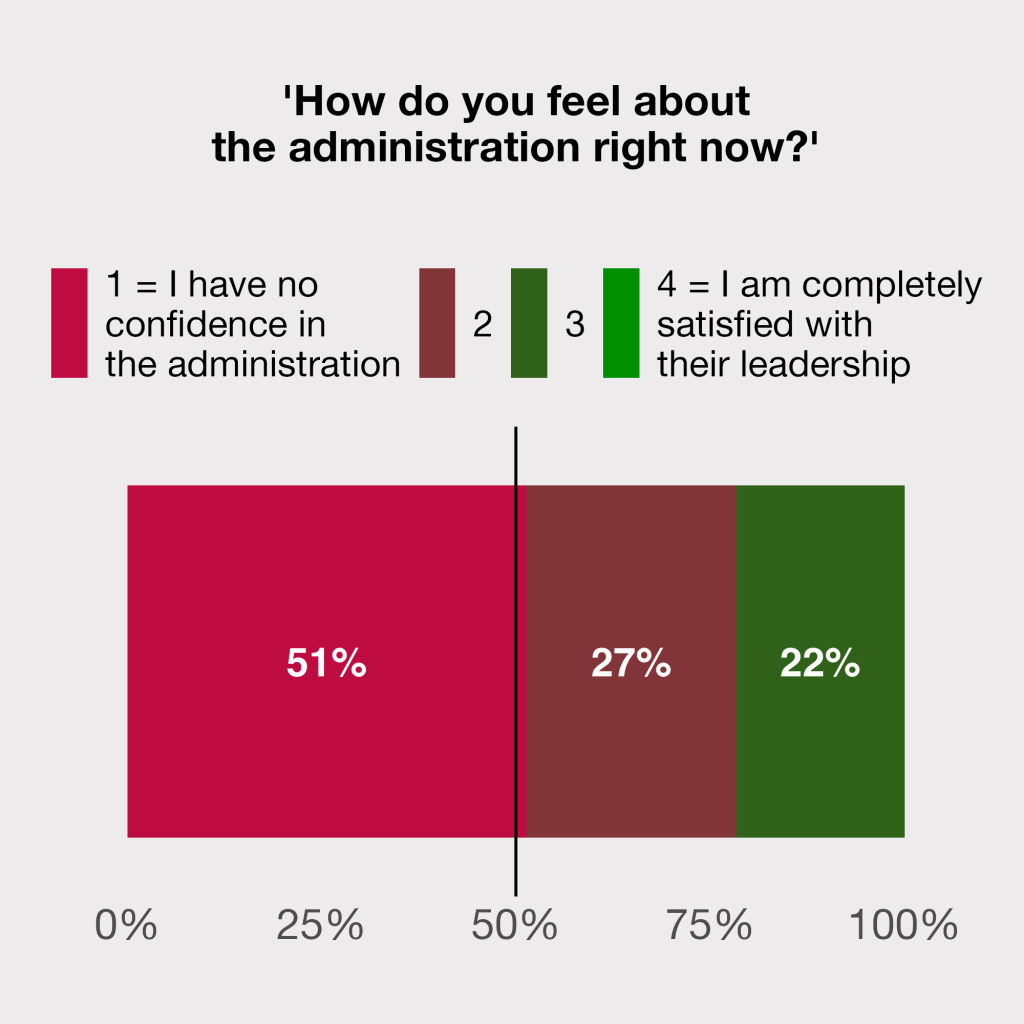
More than half the respondents (51%) expressed feeling “no confidence” in the university administration, and none reported complete satisfaction with their leadership. On a four-point scale where 1 = “I have no confidence in the administration” and 4 = “I am completely satisfied with their leadership ,” more than three-fourths (78%) of respondents chose 1 or 2 (median = 1.0). On average, GU-AAUP faculty had slightly less confidence in the administration than non-AAUP faculty (median = 1.0 and 2.0, respectively).
Looking for Another Job
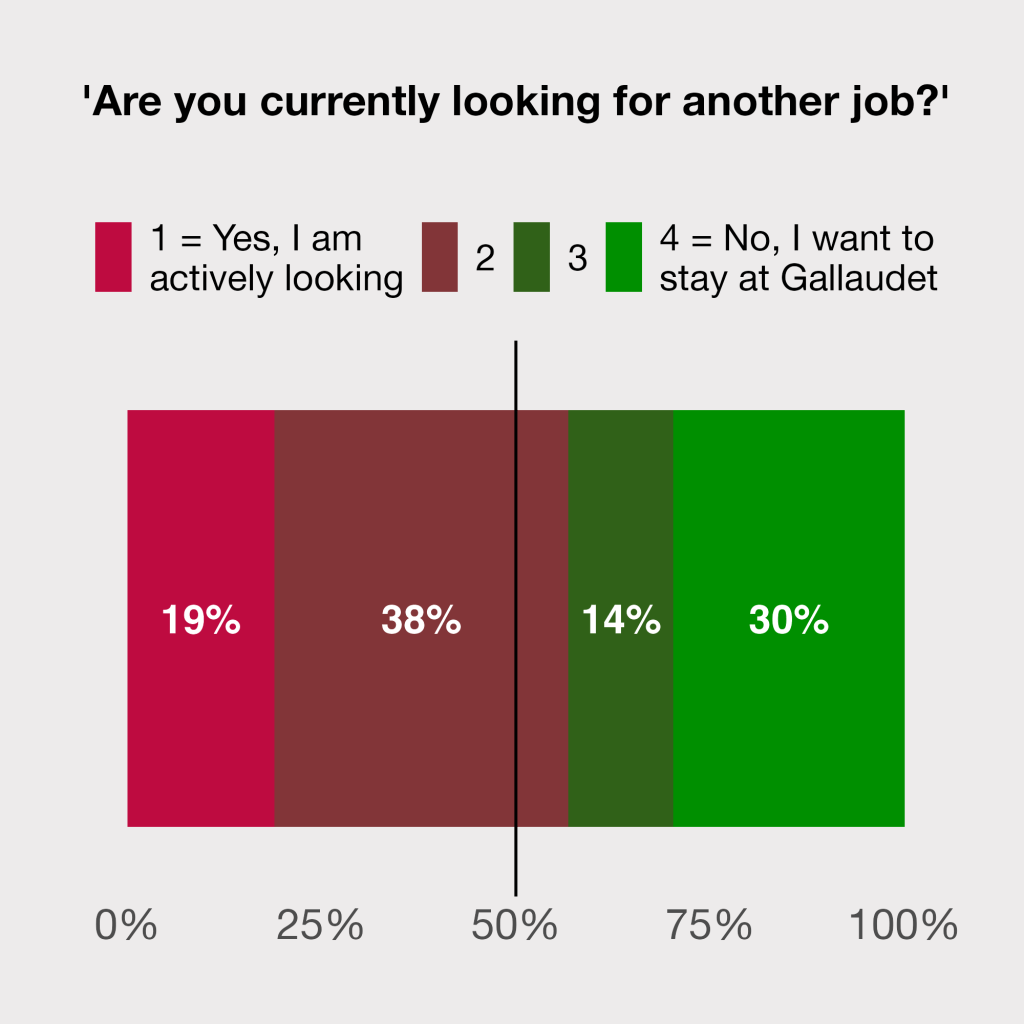
Only 30% of respondents reported that they were not looking for another job and wanted to stay at Gallaudet, while 19% reported that they are actively looking for another job. On a four-point scale where 1 = “Yes, I am actively looking” for another job and 4 = “No, I want to stay at Gallaudet,” more than half (57%) of respondents chose 1 or 2 (median = 2.0).
AAUP Advocacy
Both AAUP member and non-member respondents most often rated the Gallaudet AAUP chapter’s advocacy as “effective” (43% and 33%, respectively); only 6% reported feeling a lack of efficacy. On a four-point scale in answer to the question “Do you feel like the advocacy being done by the Gallaudet AAUP has been effective,” where 1 = “Yes” and 4 = “No,” 70% of all respondents, 76% of member respondents, and 60% of non-member respondents chose 1 or 2 (overall median = 2.0).


Conclusions
These survey results suggest a campus climate at Gallaudet of doubt, dissatisfaction, and curtailed freedom of expression. Many faculty report not feeling safe expressing their opinions on campus and having no confidence in the administration’s leadership, with a level of overall dissatisfaction that has led some faculty to actively seek employment elsewhere.
The Gallaudet University Chapter of the AAUP calls upon the administration to take steps for all faculty to feel safe to speak out on campus, particularly on issues relating to the administration. Further, we ask the administration to address the morale issue on campus. Per previous Open Letters, the sustained loss of merit increases and almost complete loss of COLAs has caused faculty real wages to decline by almost 40%, even in the face of rapidly rising Gallaudet administrator salaries, showing a lack of a sense of fairness and a lack of respect for our faculty and the students which we serve. Correcting this problem would be an excellent starting place to address morale.
###
The American Association of University Professors (AAUP) defends academic freedom, promotes shared governance, and advances the economic security of faculty. The Gallaudet AAUP chapter is a member of Local 6741 of the American Federation of Teachers (AFT), AFL-CIO.
Follow us on Facebook and Instagram and subscribe to our public listserv.
Notes on methodology: The response rate was 23% (37 responses from 158 full-time voting faculty). Responses may not represent opinions of all Gallaudet faculty. Possible systematic biases in the results include non-response bias (those individuals who chose to respond may differ from those who did not, such as holding stronger negative or positive opinions, or feeling more comfortable expressing their opinions) and extremity bias (in some situations, respondents tend to choose only the most extreme options on an ordered scale).
 Gallaudet AAUP