
Gallaudet administrators are among the higher-paid university administrators in the Washington, DC area, while Gallaudet faculty are among the lowest paid, according to 2023 federal salary data. Moreover, based on MIT’s Living Wage calculations, most Gallaudet faculty can no longer afford to live comfortably in the Washington, DC, area. Gallaudet is steadily losing its valuable, highly skilled, bilingual faculty. This, in turn, threatens its federally mandated responsibility to educate deaf and hard-of-hearing students and also raises concerns about the use of US taxpayer funds allocated annually by Congress.



| Position | Number of employees at Gallaudet | 2023 Gallaudet average salary |
2023 Washington, DC average salary1 |
Difference | 2023 Rank among DC universities |
|---|---|---|---|---|---|
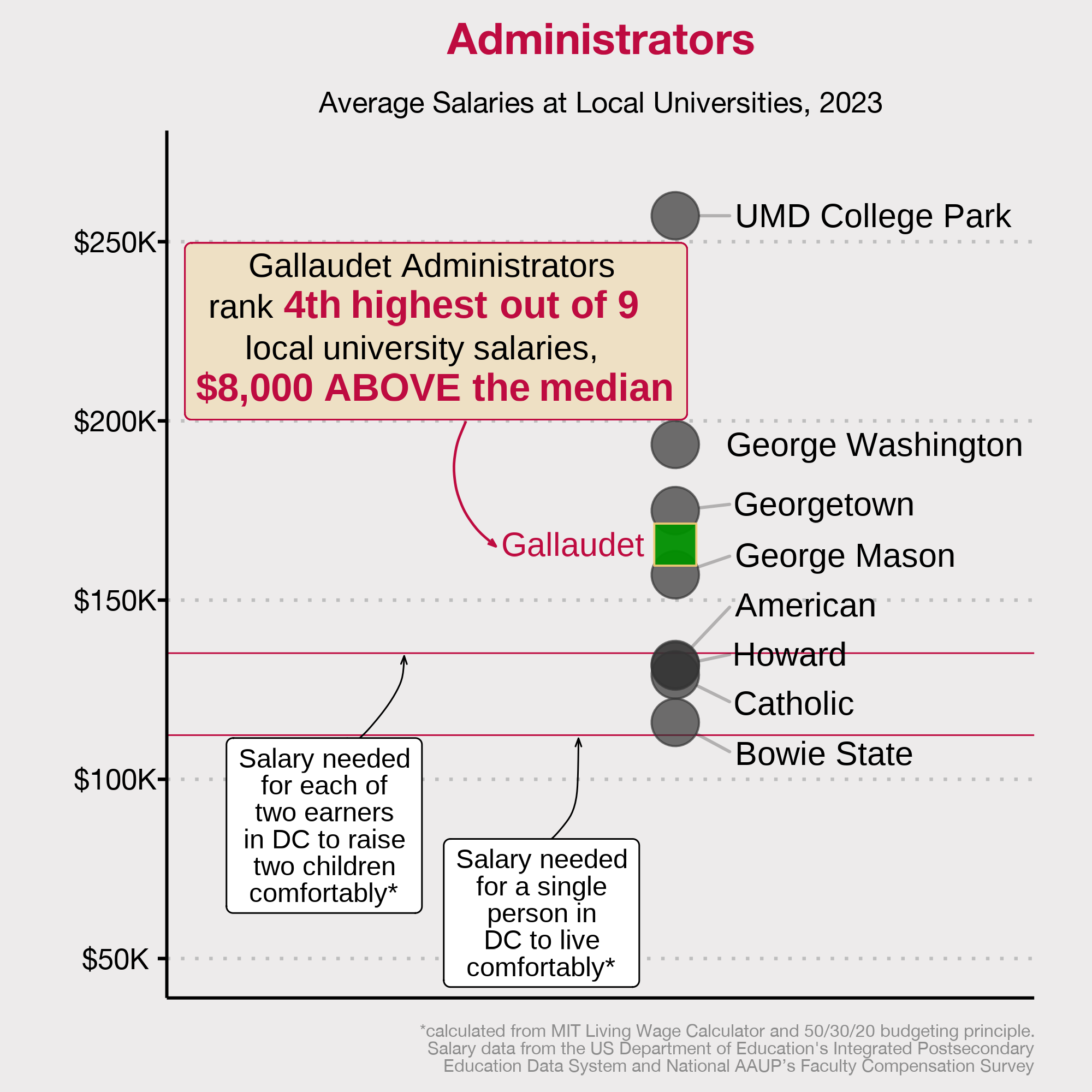
| Administrator | 55 | $165,500 | $157,100 | $8,400 more | 4th of 9 |
| Professor | 61 | $120,600 | $163,400 | $42,800 less | 9th of 9 |
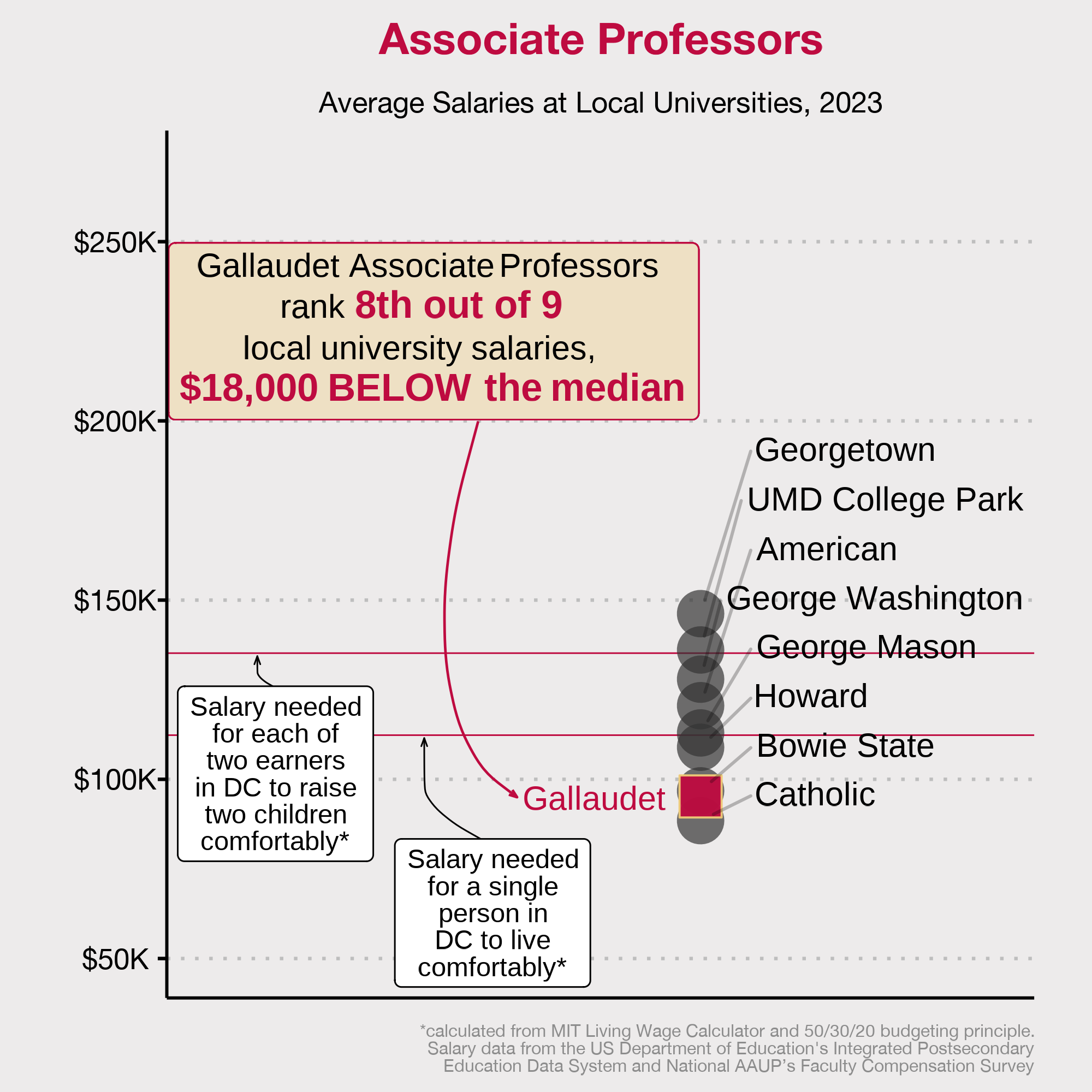
| Assoc. Prof. | 34 | $95,000 | $113,000 | $18,000 less | 8th of 9 |
| Asst. Prof. | 42 | $82,200 | $99,500 | $17,300 less | 9th of 9 |
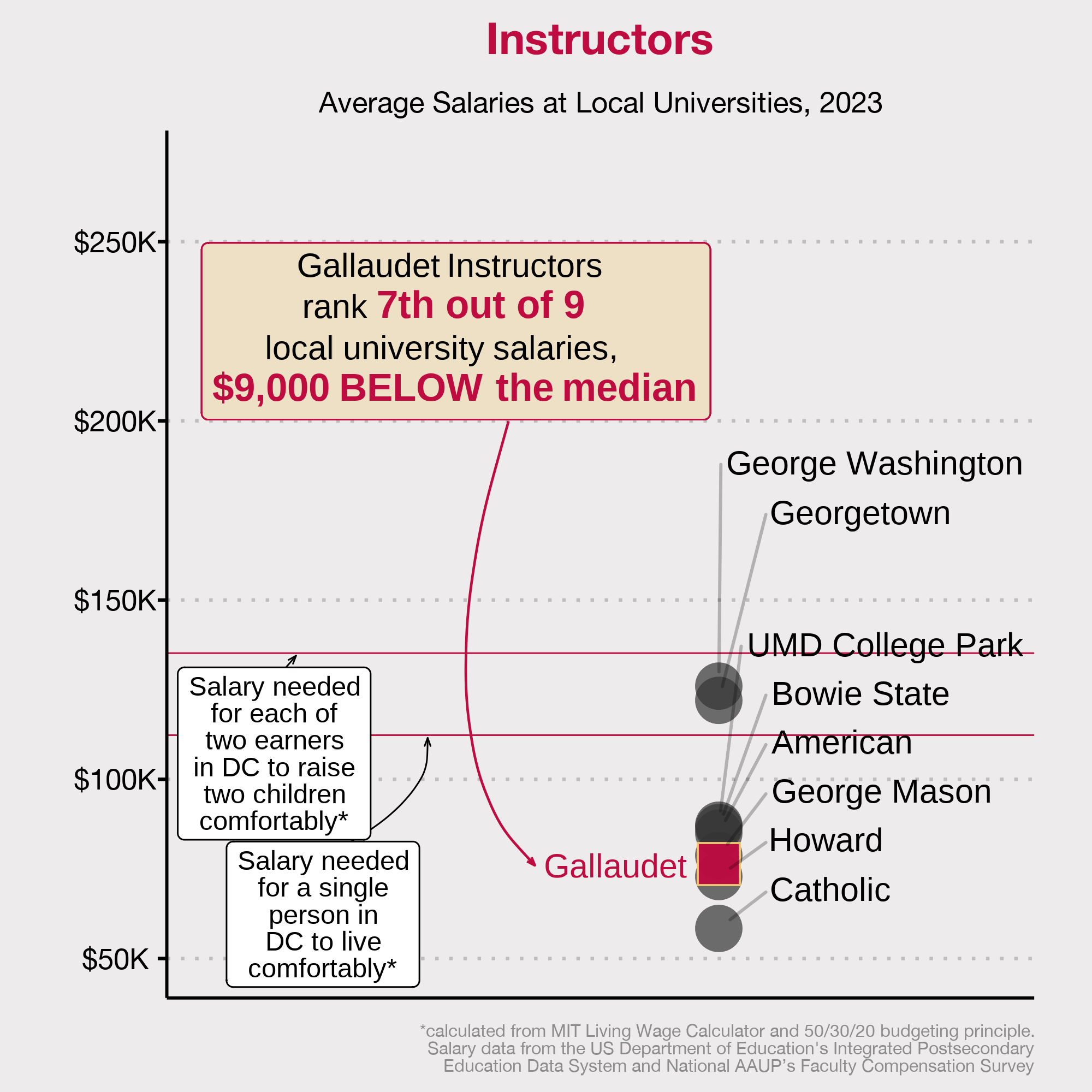
| Instructor | 11 | $76,400 | $85,000 | $8,600 less | 7th of 9 |
| See Notes for further information on calculations1 | |||||
The Gallaudet AAUP chapter’s analysis of 2023 salary data reveals a stark pay inequity between administrators and faculty at the university. While Gallaudet administrators earn an average salary $8,400 above the median of their local peers — ranking 4th highest among nine Washington, DC area institutions — faculty salaries lag significantly behind. Gallaudet’s full professors, for instance, earn $42,800 less than the local median, placing them at the bottom of the ranking (9th), while associate professors, assistant professors, and instructors earn $18,000, $17,300, and $8,600 less than the median, ranking second-lowest, lowest, and third-lowest, respectively.
Notably, if Gallaudet’s administration average salaries were adjusted to align with the local median, the university could save $462,000 annually. If administrator salaries were reduced to match their lowest-paying local peer – that is, if they were paid equitably to faculty, ranking among the bottom of their peers – Gallaudet could save $2.7 million annually.
These salary figures fall short of the cost of living in the Washington, DC area, where calculations using the MIT Living Wage Calculator and the 50/30/20 budgeting rule show that a single individual living alone requires at least $112,300 to live comfortably, and a household with two earners and two children requires salaries of at least $135,200 each.1 This means that, on average, Gallaudet’s associate professors, assistant professors, and instructors do not earn enough to live comfortably on a single income. Even two full professors earning the average salary for their rank would not be able to comfortably raise two children in the area. At present, only administrators at Gallaudet earn enough to support a family comfortably, underscoring the urgent need for salary adjustments to attract and retain qualified faculty.
Gallaudet employee salaries have lagged inflation because of the loss of Cost-of-Living Adjustments (COLAs). As a result, Gallaudet faculty do not earn enough to live comfortably in Washington, DC, according to MIT’s Living Wage Calculator and the 50/30/20 budgeting rule, recommended by many financial experts.1 Likely due to the erosion of faculty real wages, Gallaudet faculty have low morale, lack confidence in the administration, and many are actively seeking jobs elsewhere. We consider this a crisis point, because without our uniquely-qualified, bilingual and difficult-to-replace faculty, Gallaudet cannot fulfill its mandate by the Education of the Deaf Act in 20 U.S.C. § 4301(b) to “provide education and training to individuals who are deaf and otherwise to further the education of individuals who are deaf.”
###
The American Association of University Professors (AAUP) defends academic freedom, promotes shared governance, and advances the economic security of faculty. The Gallaudet AAUP chapter is a member of Local 6741 of the American Federation of Teachers (AFT), AFL-CIO.
Follow us on Facebook and Instagram and subscribe to our public listserv.
1 Notes on methodology: Salary data for 2023 were obtained from the Integrated Postsecondary Education Data System (IPEDS), maintained by the U.S. Department of Education, and from the National AAUP’s Faculty Compensation Survey. Institutions participating in Title IV federal student financial aid programs are required to report data to IPEDS annually. IPEDS provides definitions for how employees are categorized as faculty, staff (non-instructional staff), or administration (administrative staff). Institutions presented here are those that reported data to both IPEDS and AAUP. The salary figures presented here for each institution are the means within their classification as calculated and reported by the institution. The faculty salaries in both IPEDS and AAUP’s data exclude instructional faculty at medical schools. For institutions that reported different numbers to IPEDS and AAUP, the mean of their two reported figures was used. Median salaries across the nine institutions were rounded to the nearest $100 in the tables and $1,000 in the charts. The reported Washington, DC, median salary included Gallaudet University. For the charts, minimum comfortable salaries were taken by applying the 50/30/20 budgeting rule to MIT’s Living Wage Calculator for the Washington-Arlington-Alexandria, DC area; their methodology is available from their website.
Our dataset is available for download.
 Gallaudet AAUP