
This fall, the Gallaudet chapter of the AAUP conducted two anonymous surveys of voting faculty, one for AAUP members and another for nonmembers. Together, 54 of Gallaudet’s 149 voting faculty responded (36%).
The results reveal concerns about faculty compensation, shared governance, and academic freedom, including worry about reactions or retaliation for expressing opinions about University decisions.
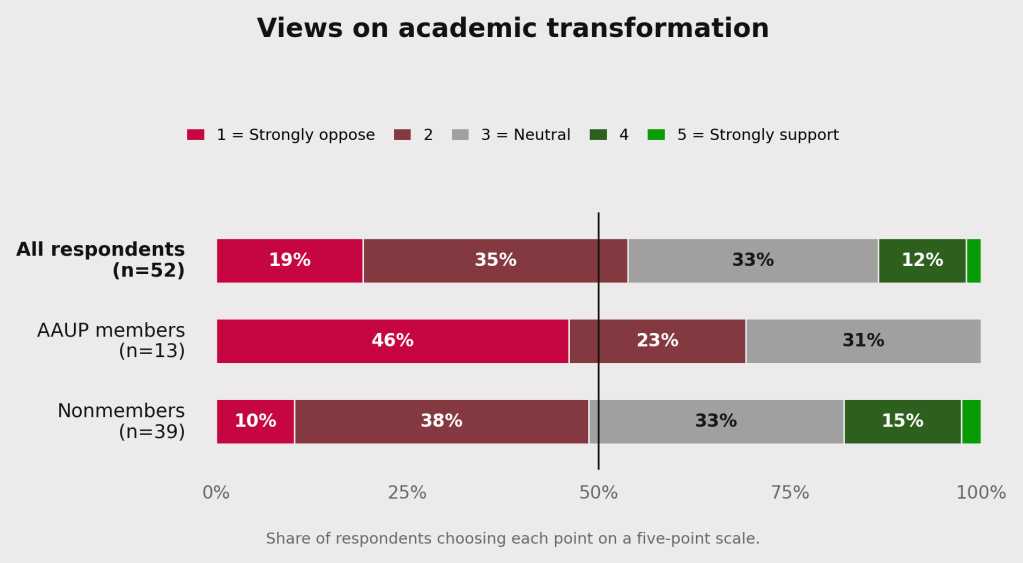
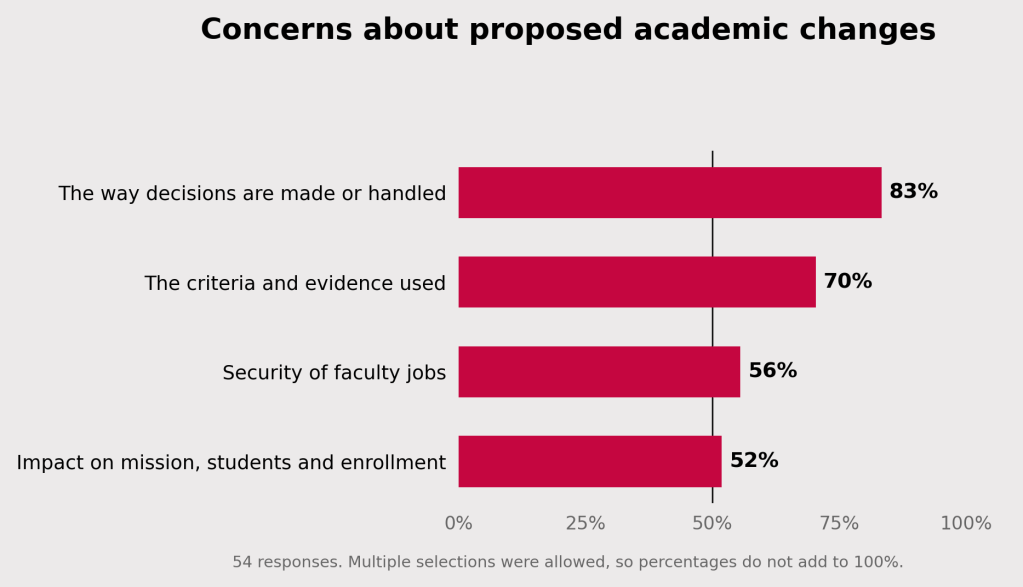
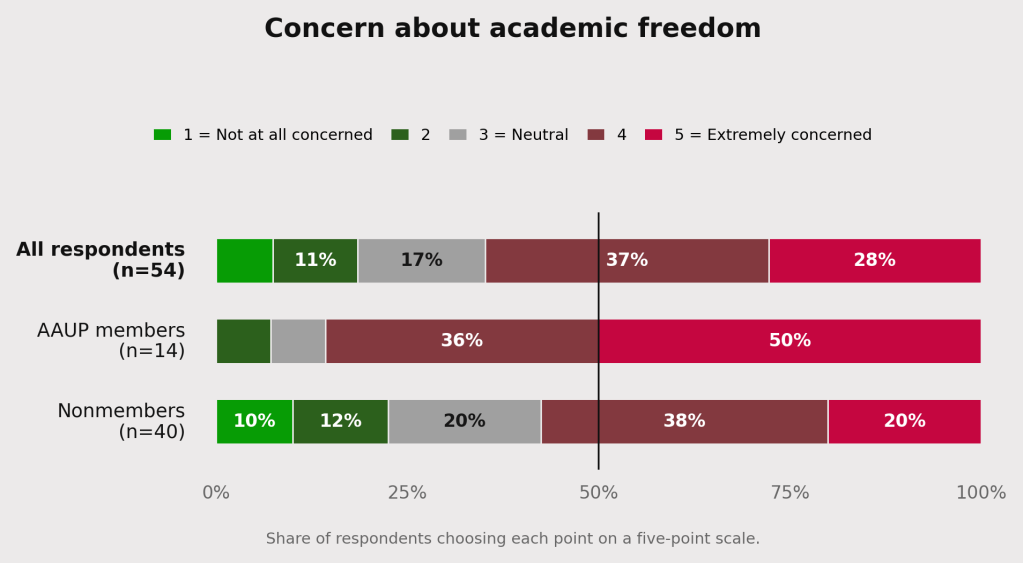
A slim majority of respondents (54%) opposed the administration’s plans for academic transformation, while a third were neutral and 13% supported them. Concern about how decisions are being made was more common still, at 83%. Majorities of both AAUP members and nonmembers also reported low confidence that the University will follow the Faculty Handbook (93% and 64%, respectively) and high concern about academic freedom (86% and 58%).
Faculty priorities
Salaries were among the two most frequently selected issues in both surveys, and workload and well-being was the second most frequently selected concern among nonmembers. Nonmembers most often selected salaries, workload and well-being, and shared governance, while AAUP members most often chose shared governance, salaries, and academic program changes as chapter priorities.
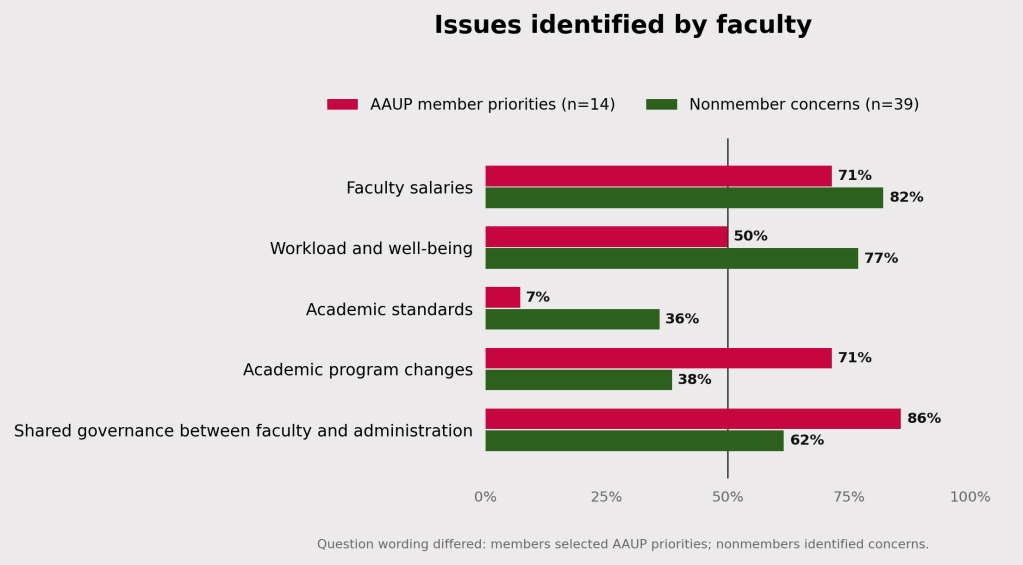
These findings reinforce concerns Gallaudet AAUP has previously raised about faculty salaries falling behind those at other Washington, DC-area universities and the loss of regular cost-of-living adjustments.
Summary of written responses: Respondents described salaries that have not kept pace with living costs, increasing workloads, and growing demands on time needed for teaching and research. Some questioned administrative transparency and whether faculty concerns meaningfully influence decisions.
Academic transformation
Opposition to the administration’s plans for academic transformation outweighed support by about four to one, although a third of respondents were neutral. Of the 52 who rated the plans, 54% opposed them (ratings 1 or 2), 33% selected the midpoint, and 13% supported them (ratings 4 or 5). Opposition was higher among AAUP members (69%) than among nonmembers (49%).
Summary of written responses: Some respondents supported restructuring or closing programs with low enrollment, while others opposed the overall direction of transformation. Across these differing perspectives, recurring concerns included limited faculty involvement, the pace of proposed changes, and evidence respondents considered unclear or disputed.
Confidence that the University would follow the Faculty Handbook
Of the 53 respondents who answered, 72% had little confidence (ratings 1 or 2) that the University would follow the Faculty Handbook in decisions about academic programs, compared with 9% who were confident. Low confidence was reported by 93% of AAUP members and 64% of nonmembers.
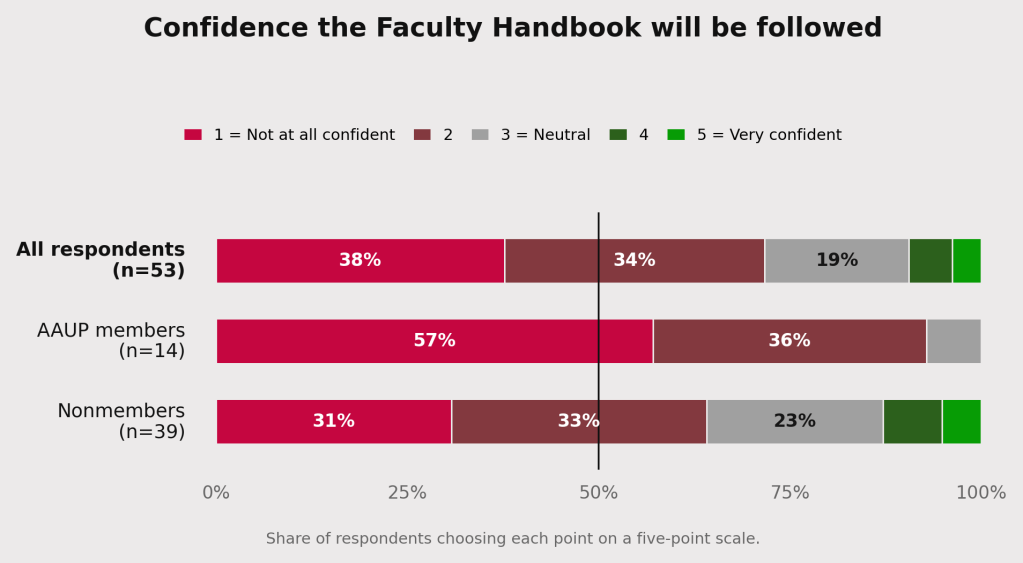
This finding matters because the Faculty Handbook sets out the procedures for academic program decisions. Faculty who support transformation and faculty who oppose it have the same interest in seeing those procedures followed.
Summary of written responses: Respondents questioned whether the University would follow established review procedures and shared governance requirements. Some felt the administration consulted faculty too late for their input to meaningfully influence decisions. Others requested clearer information about review criteria and the reasoning behind proposed changes.
Academic freedom and faculty expression
Approximately two-thirds of respondents (65%) reported high concern (ratings 4 or 5) about academic freedom at Gallaudet, including 86% of AAUP members and 58% of nonmembers.
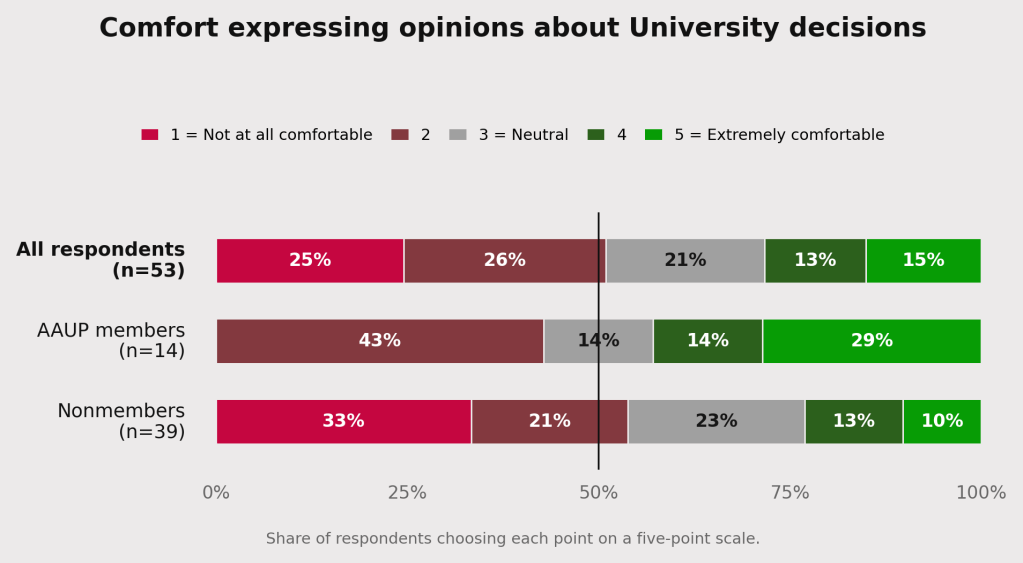
About half (51%) reported low comfort (ratings 1 or 2) in expressing opinions about University policies or decisions, compared with 28% who reported high comfort. Low comfort ratings came from 54% of nonmembers and 43% of AAUP members.
Asked why, respondents most often cited concern about reactions or retaliation from administrators. Of the 44 who answered this optional question, 37 (84%) selected it, including 82% of AAUP members and 85% of nonmembers who answered. More than half (59%) also worried that speaking openly could affect reappointment, promotion, tenure, or other personnel decisions.
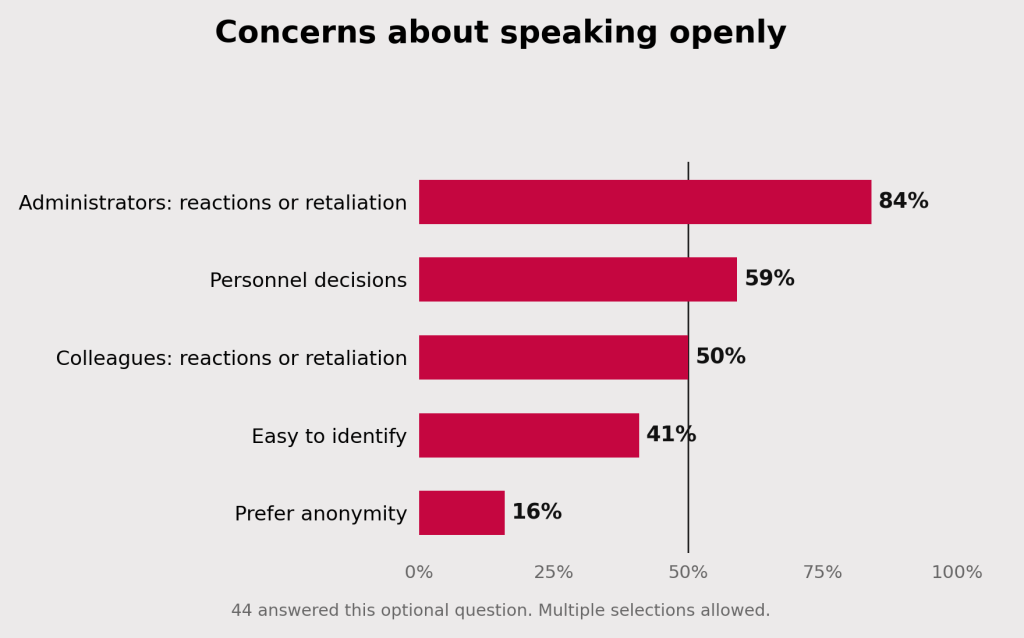
The survey does not establish that specific acts of retaliation occurred. It does document concern about the consequences of speaking openly among a majority of all respondents.
Summary of written responses: Respondents described hesitating to criticize University decisions or participate openly in faculty governance. Some reported feeling silenced after raising concerns about administrative decisions, contracts, or scholarly work. Others emphasized the particular vulnerability of untenured faculty and colleagues in small or underrepresented groups.
Conclusions
AAUP members and nonmembers raised many of the same concerns, despite differences in their priorities and their views on academic transformation. Three findings stand out.
First, salaries were a leading concern in both surveys. Salaries were the most frequently selected concern among nonmembers (82%) and tied for second among AAUP member priorities (71%). Workload and well-being was the second most frequently selected concern among nonmembers (77%).
Second, a majority of respondents expressed concern about decision-making and procedures. Although views on academic transformation differed, 83% of respondents selected concern about how decisions are being made, and 72% reported low confidence that the University would follow the Faculty Handbook.
Third, approximately half of respondents reported discomfort in expressing their opinions openly. Concern about reactions or retaliation from administrators was the most frequently selected reason. The 37 respondents who selected it represent nearly one-quarter of Gallaudet’s 149 voting faculty, even if no faculty member who skipped the survey shares that concern.
These findings deserve attention from the administration and the wider University community. Faculty may disagree about Gallaudet’s future direction, but fair compensation, meaningful shared governance, and freedom of expression are fundamental to the University’s success.
Notes on methodology: The Gallaudet AAUP chapter conducted two anonymous, voluntary surveys of voting faculty. Fourteen of 39 AAUP members (35.9%) responded between September 14 and 30, 2026, and 40 of 110 nonmembers (36.4%) responded between October 13 and 20, 2026, for a combined response rate of 36.2%. We calculated percentages using the number of respondents to each question. On five-point scales, we grouped ratings of 1 or 2 as low and 4 or 5 as high, with 3 as the midpoint. Percentages for questions permitting multiple selections may total more than 100%. In six instances, respondents exceeded the requested maximum of three selections, and we counted all selections. The priority questions differed in wording between the two surveys, so we report them separately. Several other questions differed slightly in wording but measured the same topic. Because participation was voluntary and we administered the surveys at different times, the results may not represent all voting faculty. The findings describe respondents’ perceptions and concerns, not independently verified incidents. We used AI assistance to summarize written responses, paraphrasing recurring themes while omitting identifying details.
The AAUP defends academic freedom, promotes shared governance, and organizes for fair compensation. The Gallaudet AAUP chapter is part of Advocacy Local 6741 of the American Federation of Teachers (AFT), AFL-CIO. Follow us on Instagram and subscribe to our public listserv.

